"The frequency of the waveform generator is a direct function
of the DC voltage at Terminal 8 (measured from V+). By
altering this voltage, frequency modulation is performed. For
small deviations (e.g. ±10%) the modulating signal can be
applied directly to pin 8, merely providing DC decoupling
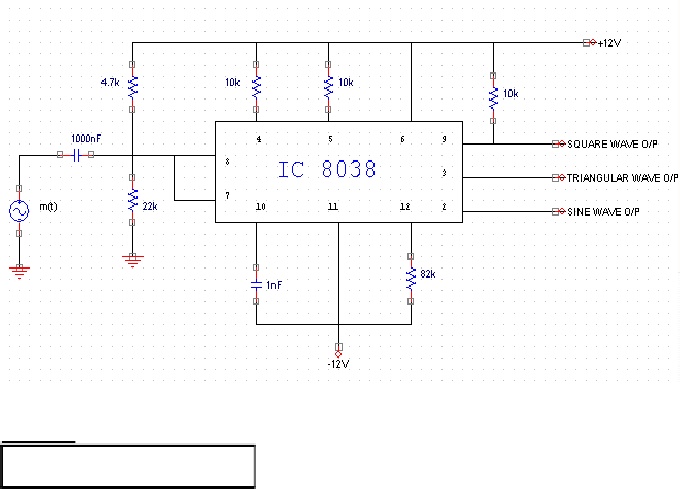
with a capacitor as shown in Figure 5A. An external resistor
between pins 7 and 8 is not necessary, but it can be used to
increase input impedance from about 8kΩ (pins 7 and 8
connected together), to about (R + 8kΩ).
For larger FM deviations or for frequency sweeping, the
modulating signal is applied between the positive supply
voltage and pin 8 (Figure 5B). In this way the entire bias for
the current sources is created by the modulating signal, and
a very large (e.g. 1000:1) sweep range is created
(f = Minimum at VSWEEP = 0, i.e., Pin 8 = V+). Care must be
taken, however, to regulate the supply voltage; in this
configuration the charge current is no longer a function of the
supply voltage (yet the trigger thresholds still are) and thus
the frequency becomes dependent on the supply voltage.
The potential on Pin 8 may be swept down from V+ by (
1
/3
VSUPPLY - 2V)."
Czy to oznacza że teoretycznie mogę korzystając z dzielnika podawać napięcie na 8 i uzyskiwać modulację na konkretnej fali nośnej? Czy ktoś wie czym mogę zmienić dewiację poza amplitudą?
Dodam że znalazłem pewne realizacje modulatora na 8038 na necie:
Ewidentne po ustawieniu pewnego offsetu podajemy sygnał wejściowy na 8(w datasheecie piszą o wstawieniu rezystora przed wejściem 7 ale to inna kwestia).
Czy ktoś zna ten układ i jest w stanie powiedzieć czym przy stałym napięciu DC i podaniu jakiejś określonej fali modulującej (prosty sinus) na wejściu 8 można zmieniać takie parametry układu jak dewiacja i częstotliwość?
Dodano po 1 [godziny] 18 [minuty]: Prawdopodobnie chodzi o stałą RC znalazłem wzór f=0.3/RC przy założeniu że oporniki na wejściach 4 i 5 wynoszą R i są sobie równe(jeśli ten warunek nie jest spełniony wypełnienie odbiega od 50%).