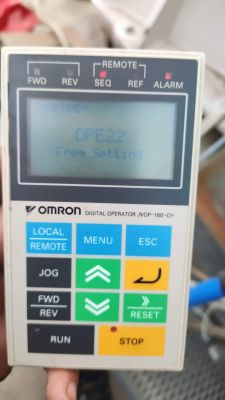
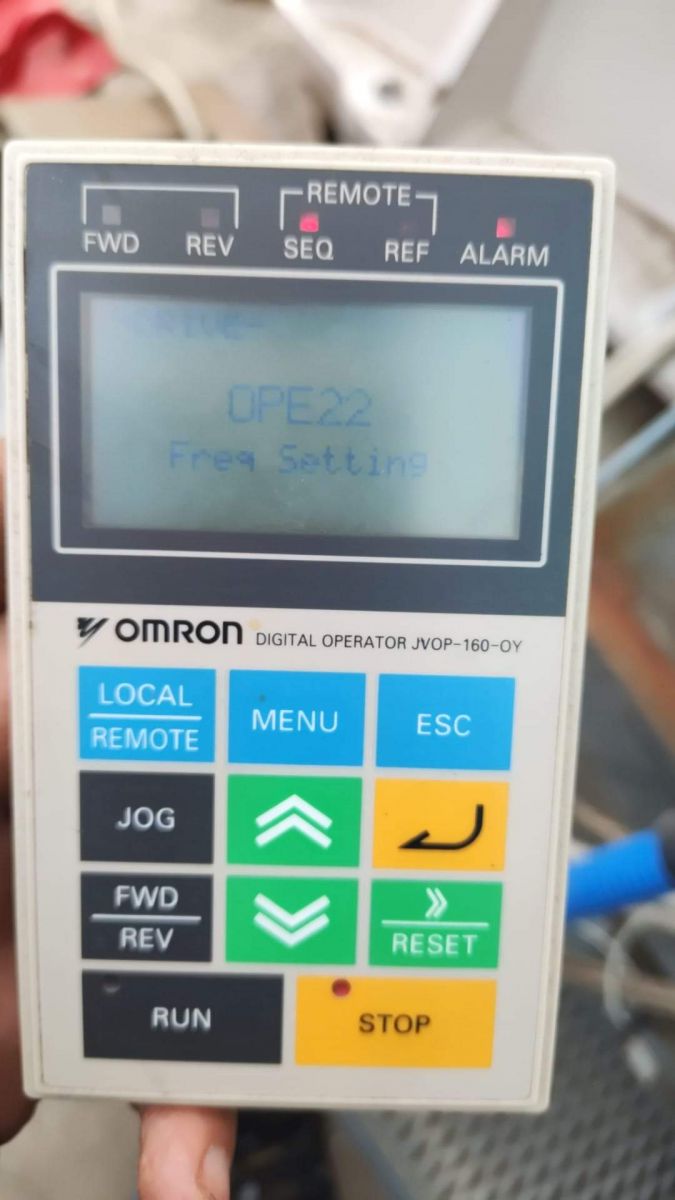
michalvw4 napisał: A1-02. Z wartości 2 na 0 i później powrót na 2
V/f Control without PG (A1-02 = 0)
• Set either one a fixed V/f pattern (E1-03=0 to E) or specify a user-set V/f pattern (E1-03=F) as required for
the motor and load characteristics using E1-04 to E1-13 in advanced programming mode.
• Perform non-rotating autotuning for the line-to-line resistance if the motor cable is 50 m or longer for the
actual installation or if a heavy load causes motor stalling. Refer to the following section on Autotuning for
details on non-rotating autotuning.
V/f Control with PG (A1-02=1)
Additionally to the V/f control without PG settings the following settings have to be made:
• Set the number of motor poles in E2-04 (Number of Motor Poles)
• Set the number of pulses per rotation in F1-01 (PG Constant). If there is a reduction gear between the
motor and PG, set the reduction ratio in F1-12 and F1-13 in advanced programming mode.
Table 4.2 Control Mode Properties
Control Mode Parameter Setting
Basic Control Main Applications
V/f control A1-02 = 0 Fixed voltage/frequency ratio control
Variable speed control, particularly
control of multiple motors with one
Inverter and replacing existing
inverters
V/f control with PG A1-02 = 1 Fixed voltage/frequency ratio control
with speed compensation using a PG
Applications requiring high-precision
speed control using a PG on the
machine side
Open Loop Vector
control
A1-02 = 2
(factory setting) Current vector control without a PG Variable speed control, applications
requiring speed and torque accuracy.
Closed Loop Vector
control A1-02 = 3 Closed Loop Vector control
Very high-performance control with a
PG (simple servo drives, high-precision
speed control, torque control, and
torque limiting)
Simple operation of a general-purpose
motor at 50 Hz:
E1-03 = 0 or F (default)
If E1-03 = F, the default setting in the user setting
from E1-04 to E1-13 are for 00 Hz
Simple operation of a general-purpose
motor at 60 Hz: E1-03 = 1
4-8
4
Open Loop Vector Control (A1-02 = 2)
Always perform autotuning. If the motor can be operated, perform rotating autotuning. If the motor cannot be
operated, perform non-rotating autotuning. Refer to the following section on Autotuning for details on autotuning.
Closed Loop Vector Control (A1-02=3)
Always perform autotuning. If the motor can be operated, perform rotating autotuning. If the motor cannot be
operated, perform non-rotating autotuning. Refer to the following section on Autotuning for details on autotuning.
Autotuning
Autotuning sets motor parameters automatically when using Open Loop or Closed Loop Vector