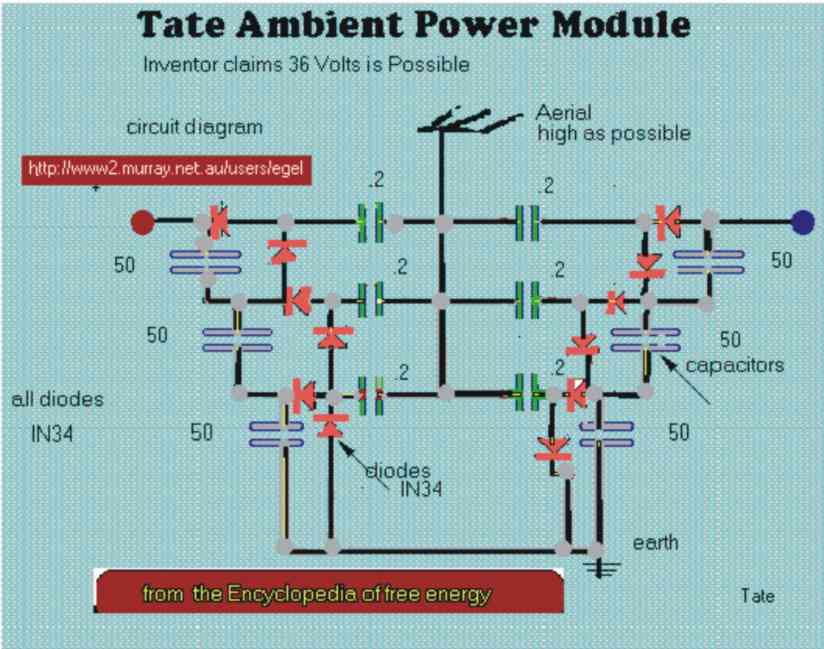
Znalazłem w sieci układ darmowego zasilania z energii fal radiowych. Może on dostarczyć napięcia 36V/9W. Niestety nie są podane wartości elementów, a jeżeli by chcieć mieć kompletny schemat, to trzeba zapłacić 9 $. Może ktoś pomoże dobrać wartości elementów. Można by wtedy mieć trochę darmowego prądu. Zamieszczam rysunek i opis.
Podr.
Tate Power from the air. Tate Ambient Power Module. Joseph Tate Last Known Address 760
Waldo Point Sausalito Ca (4965) 415 331 8150 332 9918 U.S. Patent 4,628,299 . This design converts radio frequency energy to power that can be usefully applied in power devices such as clocks, radios and smoke detectors. This design makes use of a doubler, splitter and rectifier. The device has been known to give 36 volt/9 watts. This devices does away for the need for batteries by extracting energy
from natural and man made radio waves. The device uses a coil made of the following design 479 turns of #22 wire on a 3" plastic tube, the coil should be loosely wound as a close wound coil tends to reduce power collection. One end should be connected to unit at antenna connection point and the other to an antenna of your choice . Other coil types could be used in your experiments such as sliding induction coils that is inside one another and find the best position by moving them in different positions. Other coil types can be found by referencing any good book on radio fundamentals. Check out the Tesla type coils as well.
Podr.
Tate Power from the air. Tate Ambient Power Module. Joseph Tate Last Known Address 760
Waldo Point Sausalito Ca (4965) 415 331 8150 332 9918 U.S. Patent 4,628,299 . This design converts radio frequency energy to power that can be usefully applied in power devices such as clocks, radios and smoke detectors. This design makes use of a doubler, splitter and rectifier. The device has been known to give 36 volt/9 watts. This devices does away for the need for batteries by extracting energy
from natural and man made radio waves. The device uses a coil made of the following design 479 turns of #22 wire on a 3" plastic tube, the coil should be loosely wound as a close wound coil tends to reduce power collection. One end should be connected to unit at antenna connection point and the other to an antenna of your choice . Other coil types could be used in your experiments such as sliding induction coils that is inside one another and find the best position by moving them in different positions. Other coil types can be found by referencing any good book on radio fundamentals. Check out the Tesla type coils as well.

 W latach 60-tych była głośna sprawa faceta mieszkającego w pobliżu masztu rozgłośni Warszawa I w Raszynie.