




logo elektroda
logo elektroda
X
logo elektroda
REKLAMA
REKLAMA
Adblock/uBlockOrigin/AdGuard mogą powodować znikanie niektórych postów z powodu nowej reguły.

Unibot - robot monocykl

farmazon3000 09 Paź 2007 21:04 9727 12
REKLAMA
  • Unibot - robot monocykl

    Źródło:
    http://hackedgadgets.com/2007/10/08/unibot-3d-stabilization/
    http://sicl.ucsd.edu/jaschavp/Welcome.html

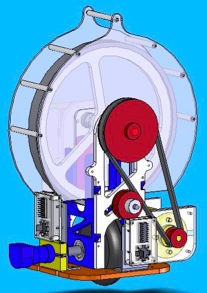
    Unibot, którego autorem jest Jascha van Pommeren, jest samostabilizującym się robotem - monocyklem. Robot łączy w sobie zasady popularnego w świece robotyki kołowego odwróconego wahadła oraz koła zamachowego.

    Dobrze znanym przedstawicielem kołowego odwróconego wahadła jest Segway. Ujmij Segway'owi jedno koło i dodaj drugie nad kołem które zostało i Unibot gotowy!
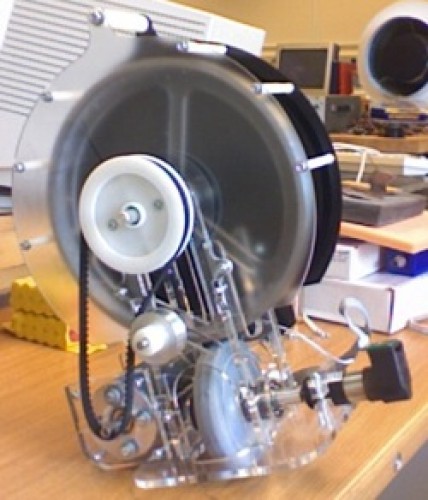
    Unibot - robot monocykl

    Koło na ziemi używane jest do stabilizacji w płaszczyźnie Y-Z. Koło znajdujące się w powietrzu służy do balansowania robotem w płaszczyźnie X-Z.

    Widać od razu, że ten układ jest niestabilny gdy nie zastosujemy żadnego sterowania. Żeby uzyskać stabilny system oba koła są poruszane przez silniki DC.
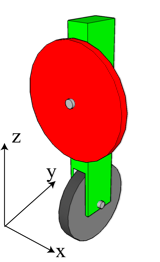
    Unibot - robot monocykl

    Dynamika systemu jest podzielona na dwa dwuwymiarowe systemy. Każdy z nich zawiera jedno koło i jeden motor. Dla uproszczenia, dynamika obu systemów przyjmowana jest przyjmowana jako oddzielna.

    Obecnie budowany jest prototyp robota. Akrylowe fragmenty ramy zostały wykonane przy użyciu maszyny Lasercamm. Większość części układu jezdnego została kupiona, niektóre zostały zrobione konwencjonalnymi metodami (toczenie).

    W obydwu płaszczyznach ruchu używany jest żyroskop i akcelerometr do mierzenia kątów i prędkości kątowych robota. Oba motory mają enkodery optyczne do mierzenia względnych kątów między kołami a ciałem robota.


    Fajne? Ranking DIY
    O autorze
    farmazon3000
    Poziom 15  
    Offline 
    farmazon3000 napisał 259 postów o ocenie 25, pomógł 3 razy. Jest z nami od 2005 roku.
  • REKLAMA
  • #2 4364295
    Duch__
    Poziom 31  
    Ciekawe urządzenia. Ciekaw jest jakby się ten robocik zachowywał na silnym bocznym wietrze :)
  • #3 4364586
    michal512
    Poziom 14  
    robocik fajny. Troche dużą dewładnosć ma to duże koło.. ale działa jak nałeży :P
  • REKLAMA
  • #4 4364587
    XAX
    Poziom 21  
    Hehe fajna zabawka.

    To ciągłe bujanie jego może doprowadzić człowieka do mdłości nawet prze monitorem.
    Szkoda że nie mam takiej wycinarki do akrylu. Jakie cuda można by konstruować.
  • REKLAMA
  • #5 4364629
    Kuniarz
    Moderator Projektowanie
    niezłe, aczkolwiek Tina Turner w tle świadczy o dobrym guście muzycznym autora projektu ;-)
    Pomogłem? Kup mi kawę.
  • #6 4364722
    morph13
    Poziom 25  
    Ciekawa konstrukcja.
    Pamiętam, że jakiś czas temu Japończycy zaprezentowali robota jeżdżącego na rowerze a za stabilizacje położenia pionowego odpowiadała obracająca się "masa" wewnątrz robota.
    Tu zasada utrzymania pionu jest identyczna.
  • #7 4364821
    jaschaaa
    Poziom 2  
    Hi everyone,

    Nice to see my robot here. What the hell do all your posts mean? My Polish is not that great... ;)

    jascha
  • REKLAMA
  • #8 4364951
    kafka
    Poziom 22  
    That posts mean that unlike Polish your robot is great ;)
  • #9 4365118
    dex
    Poziom 27  
    Link do robota jeżdżącego na rowerze jest na youtube jako "response" do tegoż filmiku.
  • #10 4365966
    Kubaj
    Poziom 15  
    It's rather unusual, that english-speaking designer and/or constructor dares to post his reply on a .pl forum :-s.
    ->jaschaaa: anyway, the point of discussion is an overall approbate for the project. However, according to the opinions of others, the bigger wheel may be having a slightly too high inertia? Btw, how did you manage to make such a brilliant, precise acrylic cut for the cover? What CNC did you use?
  • #11 4366017
    burnet99999
    Poziom 12  
    Ciekawe urządzenia jest robot pracuje na silnym bocznym stabilazator (czyli koło zamachowe). Ocena 5/5

    Moderowany przez androot:

    Mimo usilnych prób wielu moderatorów nie udało sie temu użytkownikowi wytłumaczyć pewnych zasad na forum. Myślę, że bez niego będzie wszystkim łatwiej...

  • #12 4366170
    MichałKob
    Poziom 20  
    OK... Jascha, can you please tell me how the Unibot manages to keep vertical position using the big wheel? Is there an additional mass attached to the big wheel? Let me know if my thinking is right: I think that the momentum working on the wheel is the same that the momentum working on the bot. That`s why, in zero gravity, the bot would spin around in one direction and the wheel in another. I think that you might add a third wheel, so that your bot could change the direction of movement.
  • #13 4366521
    jaschaaa
    Poziom 2  
    @ Kubaj:

    >However, according to the opinions of others, the bigger wheel may be
    >having a slightly too high inertia?
    The funny thing is, the bigger the inertia of the big wheel, the better its stabilizing ability will be. Objects in rotation are sometimes harder to understand than things that translate. Think of to masses of which one pushes itself away from the other. If the one that pushes itself away is heavier (more inertia in rotation) than the other, the other will also move.

    Another thing:
    The mass of the wheel is a trade-off. A bigger mass will lead to a bigger inertia. However, the wheel mass is also part of the mass that has to be kept upright, so it should not be too large either.

    >Btw, how did you manage to make such a brilliant, precise acrylic cut for >the cover? What CNC did you use?
    I used a CNC CO2-laser to cut the acrylic parts.

    @ MichałKob:

    >OK... Jascha, can you please tell me how the Unibot manages to keep
    >vertical position using the big wheel? Is there an additional mass
    >attached to the big wheel?
    There is no extra mass attached to the wheel. I actually tried to balance the wheel as much as possible (what was hard, because it was made out of a piece of old pipe). The principle behind the stabilization is one of Newton's laws: action = -reaction. In this case: applying a torque to the wheel causes a (more or less) opposite torque to the body of the robot.

    >Let me know if my thinking is right: I think that the momentum working
    >on the wheel is the same that the momentum working on the bot.
    You probably mean moment instead of momentum. If my assumption is right, your way of thinking is right.

    >That`s why, in zero gravity, the bot would spin around in one direction >and the wheel in another.
    I don't share this idea with you. Gravity is causing the robot to be unstable. Without gravity the big wheel would be able to have the robot sit in every angle one can think of. The bot will not be spinning. Actually this principle is also used in satellites. I haven't seen them spinning ;)

    >I think that you might add a third wheel, so that your
    >bot could change the direction of movement.
    A third wheel to control yaw would be nice. However, there are possibilities of making turns, using only the two wheels the robot has now. Majima & Kasai wrote an interesting paper about this. I haven't done experiments on this, because the cables to and from the robot would be too disturbing.
REKLAMA
